Don't take that 4-inch slot in your air handler for granted. A 14x18x4 filter handles the same load as three to four 1-inch filters before it needs replacing, and most homeowners we meet didn't realize they had that option until they pulled open the cabinet door.
At Filterbuy, we've been making filters in the United States for over a decade. Across millions of customer orders, we've watched the same pattern: a household swaps a thin panel filter for the deeper kind, and two things change. The air at the registers feels cleaner, and the maintenance calendar gets shorter. This guide walks every Prudent Protector through what we wish they knew before they bought, plus where the 4-inch upgrade fits alongside professional HVAC maintenance. When you're ready, you can shop our American-made 14x18x4 air filters in MERV 8, 11, or 13 straight from the factory.
TL;DR Quick Answers
Dimensions: 14" wide, 18" tall, 4" deep. Measure your cabinet first.
Best MERV pick: MERV 11 for most households. Move up to MERV 13 if anyone has asthma or wildfire smoke is part of your year.
Replacement schedule: every 6 to 12 months.
Install rule: the airflow arrow on the frame has to point toward the blower.
The payoff: cleaner indoor air, a healthier HVAC system, and fewer filter swaps a year.
Top Takeaways
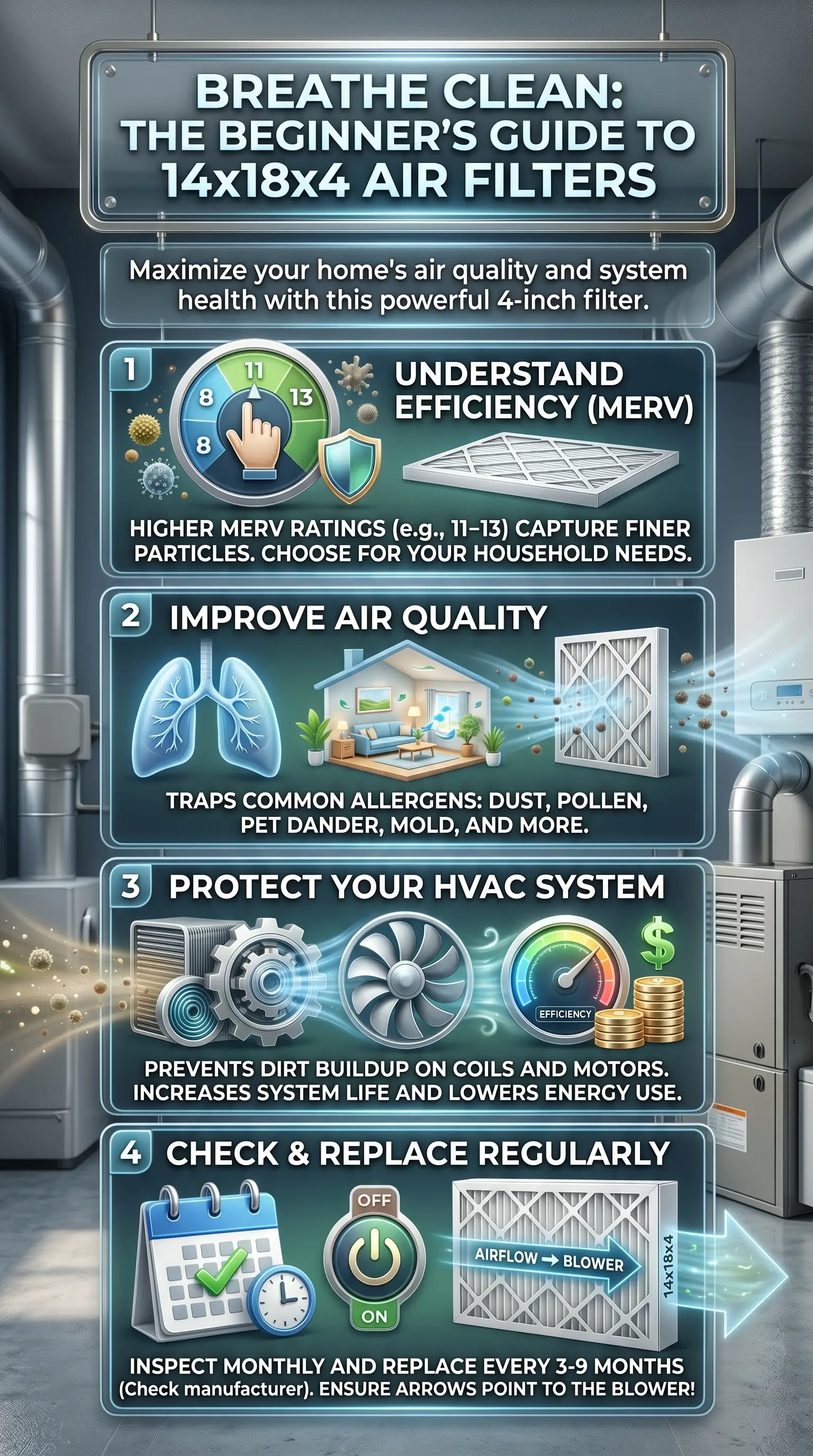
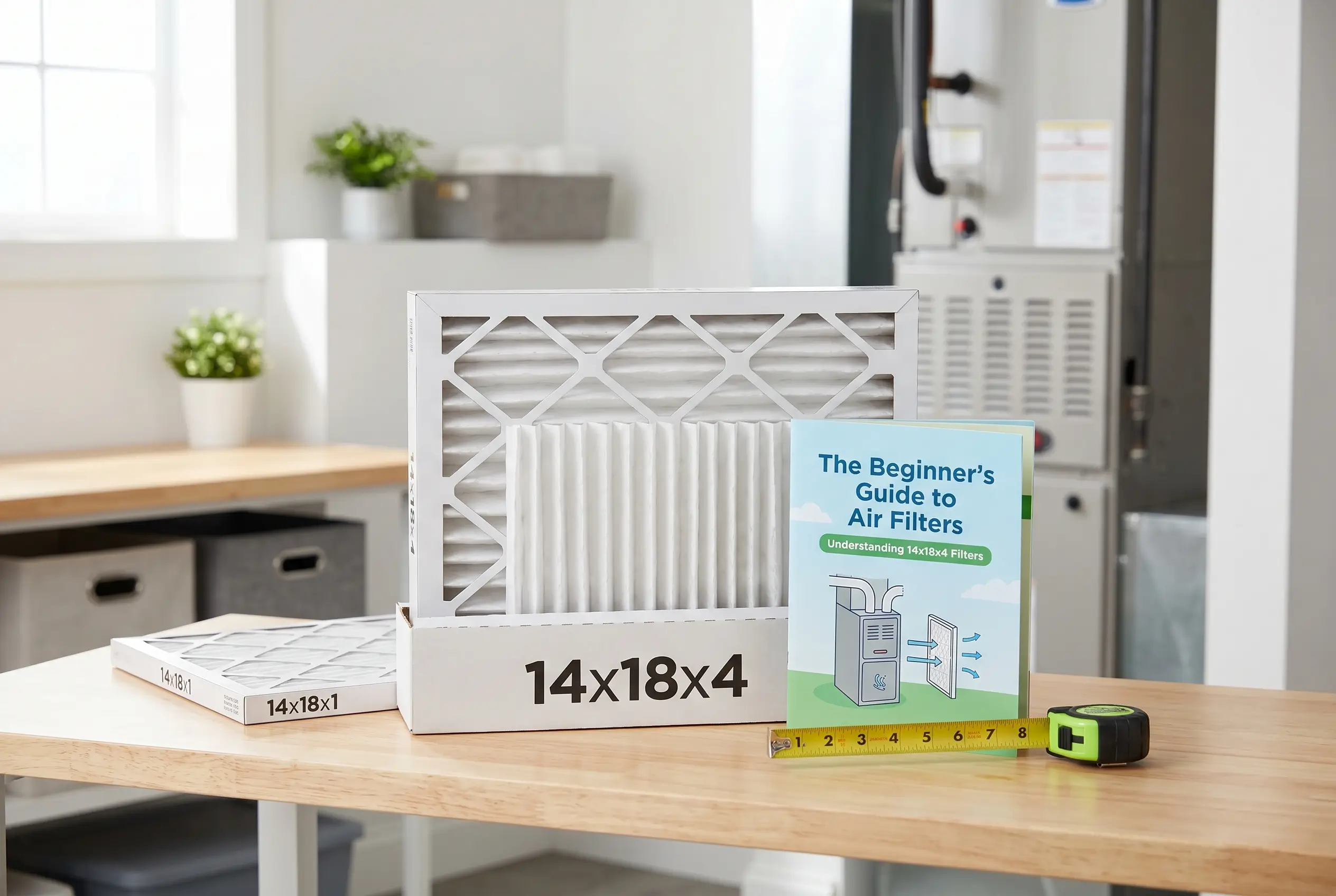
The size reads width by height by depth, so 14x18x4 is a 4-inch deep filter that's 14 wide and 18 tall. Measure before you order.
A 4-inch filter has many more pleats than a 1-inch filter, which means more surface area to catch particles and a service life that often runs 6 to 12 months.
MERV 8 covers basic dust and lint, MERV 11 handles pets and seasonal allergies, and MERV 13 is the better pick for asthma sufferers, infants, or wildfire smoke (as long as your blower can handle the added resistance).
The airflow arrow on the frame has to point toward the blower. Install it backwards and the filter won't seal properly or do its job.
If 14x18x4 doesn't match your unit, custom filter sizes can be cut to fit non-standard cabinets.
What You Need to Know About 14x18x4 Air Filters
The numbering describes the filter's footprint and depth in inches: 14 wide, 18 tall, 4 deep. That 4-inch depth is the part beginners miss. With more depth, the manufacturer can fold in many more pleats, which gives the filter more surface area to catch particles and creates much less airflow resistance than a 1-inch filter doing the same job. The pleated filter basics all trace back to that one geometry decision.
A pleated air filter catches airborne particles like dust, pollen, mold spores, smoke, and pet dander before they reach your lungs or the inside of your HVAC system. At Filterbuy, our whole job is making the invisible visible. The 4-inch depth is what lets a single filter handle the same load as three to four 1-inch filters.
Sizing & Compatibility
Check that your filter slot is exactly 4 inches deep before you buy anything. Read the nominal size printed on your existing filter (something like 14x18x4). The actual cut size will be a little smaller, usually around 13.5 by 17.5 by 3.75 inches, so the filter slides in snugly without binding. If your cabinet is only 1 inch deep, a 4-inch filter won't fit and you'll need a different depth. The same fit-first principle applies to central AC filters of every size. Measure first. Order second.
MERV Ratings, Translated
MERV stands for Minimum Efficiency Reporting Value. The scale runs 1 to 16, and the bigger the number, the smaller the particle the filter can catch. For a 14x18x4 filter, we recommend MERV 8 if you mostly need to handle dust and lint, MERV 11 if anyone in the house has pets or seasonal allergies, and MERV 13 if anyone has asthma, you're caring for a baby or older parent, or wildfire smoke is part of your year. Confirm your blower can handle MERV 13 before you buy. Not every system is built for that level of resistance, and matching the filter to your equipment is what actually delivers peak tune-up performance.
If allergies are severe in your house or you live where smoke shows up every summer, a layered approach works best. Pair a high-MERV filter at the HVAC with a separate air purifier installation for room-level cleaning. During fire season, our customers also lean on a few wildfire smoke tips to keep the rest of the home buttoned up.
Replacement Schedule
Because of the deeper pleated surface, a quality 14x18x4 filter usually lasts 6 to 12 months. That's far longer than a 1-inch filter, which most homes are changing every 1 to 3 months. Pets, smoking, recent renovation work, or wildfire season can shorten the window. Want a quick visual check? If the pleats look gray and the airflow at your registers feels weak, the filter is done. Some households also look at reusable filter options, though for most cabinets a quality disposable pleated filter still wins on capture efficiency.
Pro Tip from our manufacturing team: write the install date on the filter frame with a permanent marker the moment you put it in. Across millions of customer orders, this single habit gets more people back on schedule than any reminder app.
Installation in 60 Seconds
Turn off the HVAC at the thermostat. Slide the old filter out of the cabinet. Look at the airflow arrow on the new filter and make sure it points toward the blower or furnace. Slide the new one in flat, close the cabinet, restart the system, and write the install date on the frame.
“After more than a decade of making filters and reviewing millions of customer orders, the most expensive beginner mistake we see has nothing to do with picking the wrong MERV. It's installing the filter backwards, which kills airflow, wears down the blower, and undoes the work the filter was supposed to do.”
When customers want to keep learning, these are the non-commercial sources we point them to first.
U.S. EPA, Guide to Air Cleaners in the Home: epa.gov/indoor-air-quality-iaq/guide-air-cleaners-home. The EPA's plain-language explainer on how furnace and HVAC filters reduce indoor pollutants.
National Air Filtration Association (NAFA), Understanding MERV: nafahq.org/understanding-merv-nafa-users-guide-to-ansi-ashrae-52-2. The official industry primer on the ASHRAE 52.2 standard behind every MERV number.
ENERGY STAR, Heat & Cool Efficiently: energystar.gov/saveathome/heating-cooling. Government-backed guidance on filter checks and HVAC efficiency from the EPA's ENERGY STAR program.
U.S. Department of Energy, Air Conditioner Maintenance: energy.gov/energysaver/air-conditioner-maintenance. Why a clean filter protects the evaporator coil and extends system life.
CDC (NIOSH), Improving Air Cleanliness: cdc.gov/niosh/ventilation/prevention/air-cleanliness.html. Public-health rationale for upgrading central HVAC filters to MERV 13 when compatible.
American Lung Association, Air Cleaning: lung.org/clean-air/indoor-air/protecting-from-air-pollution/air-cleaning. Respiratory-health perspective on HVAC filtration and MERV upgrades for sensitive households.
AirNow, Indoor Air Filtration Factsheet: airnow.gov/sites/default/files/2020-10/indoor-air-filtration-factsheet_1.pdf. Interagency factsheet on filtration during wildfire smoke and high-pollution events.
3 Statistics That Make the Case for Better Filtration
Americans spend roughly 90% of their time indoors, and pollutant levels in those spaces are often 2 to 5 times higher than typical outdoor air. Source: U.S. EPA, epa.gov/report-environment/indoor-air-quality.
About half of the energy a typical home uses goes to heating and cooling, which means a clogged filter forces that system to work harder and burn through more electricity. Source: ENERGY STAR, energystar.gov/saveathome/heating-cooling.
The CDC recommends upgrading central HVAC filters to MERV 13 or higher whenever the system can support it, to capture exhaled viral particles and outdoor pollution. Source: CDC NIOSH, cdc.gov/niosh/ventilation/prevention/air-cleanliness.html.
Final Thoughts and Opinion
Here's our honest take after more than a decade of making filters in the U.S. A 14x18x4 is one of the few home upgrades where the best choice for your HVAC equipment, your energy bill, and your family's lungs all line up. The upfront price runs higher than a 1-inch filter, and the math still works in your favor: fewer filter swaps a year, more life from the blower, and cleaner air at the registers between changes. We don't believe in fear-marketing about indoor air. We do believe in Better Air For All, which starts with giving Prudent Protectors the facts and the right product, made well, the first time. If something goes sideways with your system, get a few HVAC repair estimates from a trusted local technician before paying for emergency service, and compare AC repair quotes in your area so you're not overcharged. Match the MERV to your household, change the filter on schedule, and keep going.
Frequently Asked Questions
Is a 14x18x4 the same as a 14x18x5 filter?
No. The depth is different, and a 5-inch filter won't seat correctly in a 4-inch cabinet. Air will bypass the filter media instead of passing through it. If your slot is actually 5 inches deep, look at 5-inch filter options sized for that exact depth.
What if my home uses a different filter size?
You're not stuck. Larger 4-inch sizes are made for big media cabinets, and a comparable filter size is widely stocked for the popular 14x25x1 slot. Always match all three dimensions printed on your old filter.
How often should I replace a 14x18x4 filter?
In a typical home, every 6 to 12 months. Cut that down to every 3 to 6 months if you have multiple pets, smokers, recent construction dust, or a wildfire-smoke season.
What MERV is best for allergies?
MERV 11 is the all-around pick for households with pets and seasonal allergies. MERV 13 is better for asthma sufferers, infants, or older family members, as long as your HVAC system can handle the added resistance.
Can a higher MERV damage my HVAC?
It can if your system isn't designed for the added airflow resistance. If you're not sure, start at MERV 11 or check your equipment manual for the maximum recommended MERV.
Do thicker filters really save money over time?
Yes. You're paying for fewer replacements a year and a cleaner blower assembly that runs more efficiently. If you're comparing the price to thinner 1-inch options, remember that a single 4-inch filter usually replaces three to four 1-inch filters across a year.
Why is the actual filter slightly smaller than 14x18x4?
“14x18x4” is the nominal size. The actual cut size is usually about 13.5 by 17.5 by 3.75 inches, so the filter slides smoothly into the cabinet and seals properly on all four sides.
Ready to Breathe Easier?
You're the hero of your home's air quality, and the right filter is the simplest move you can make today. Filterbuy makes every 14x18x4 filter here in the United States, ships free, and offers Auto-Delivery so the next replacement arrives before you need it. Pick your MERV, set your schedule, and let us handle the rest. Our 14x18x4 is also available online and through additional retailers for shoppers who like to consolidate orders.
Tap here to shop our American-made 14x18x4 air filters and protect what matters most.
Learn more about HVAC Care from one of our HVAC solutions branches…
Filterbuy HVAC Solutions - Miami FL - Air Conditioning Service
1300 S Miami Ave Apt 4806 Miami FL 33130
(305) 306-5027